
Sales tax on vitamins and supplements is tricky because states classify them differently. They could be taxable in one state but exempt in another.
Navigating sales tax for vitamins and supplements is like a maze. States treat them differently, and exemptions vary. So, vitamins and supplements could be tax-free in one state but fully taxable in another.
This makes compliance a headache for any seller in the nutritional supplements market. Fortunately, automation streamlines the process so that you can focus on growth.
Why Sales Tax on Vitamins And Supplements Is Complicated
Sales tax on vitamins and supplements falls into a gray area, making classification challenging. One state may treat them as food products, another as medicines, and some as taxable over-the-counter (OTC) goods. As food products and prescription drugs, they can be exempt, but they don't fit into either category. As a result, some states tax them like regular OTC products. On the other hand, others exempt them if they are labeled or prescribed as medicine.
Worse, state regulations on vitamins could change anytime, making it even more difficult for retailers. Many admit they struggle to keep up, while others have to update their systems frequently. This makes compliance a moving target, making it costly and at high risk of audits and penalties.
Examples of State Differences
States don't agree on how to treat vitamins and supplements, and the differences can be dramatic. For instance, most dietary supplements in California are taxable because they aren't considered "food." Meanwhile, Texas exempts dietary supplements when they carry a "Supplement Facts" label, treating them like food products.
New York exempts prescriptions but taxes most non-prescription supplements as ordinary over-the-counter items. Other states, like Michigan or New Jersey, exempt supplements broadly as food. However, Minnesota considers them taxable. Additionally, local jurisdictions like Colorado home-rule cities or Alaska municipalities may add their own rules.
The varying state regulations on vitamin laws show how inconsistent classifications can be. What's taxable in one place may be completely tax-free in another. The varying tax rules create different tax obligations. So, regularly checking each state's exemption list and definitions is critical for compliance.
How States Classify Vitamins and Supplements
State tax treatment of vitamins and supplements depends heavily on their classification. Products labeled "Nutrition Facts" are treated as conventional food. In contrast, those with a "Supplement Facts" label are considered dietary supplements under the Dietary Supplement Health and Education Act (DSHEA).
The label determines whether the item is exempt. Some states exempt food from sales tax, including "Nutrition Facts" dietary supplements. However, some tax them like over-the-counter items. As a result, a vitamin product could be taxed in one state but exempt in another.
Here's an overview of how states classify vitamins and supplements.
State | Taxable as OTC Medicine | Exempt as Food | Exempt as Medicine (Rx) |
|---|---|---|---|
Alabama | Yes | No | Yes (Rx) |
Alaska | N/A – no state sales tax (local rules vary) | N/A | N/A |
Arizona | Yes | No | Yes (Rx) |
Arkansas | Yes | No | Yes (Rx) |
California | Yes | No | Yes (Rx) |
Colorado | Yes (note home-rule locals) | No | Yes (Rx) |
Connecticut | No (non-Rx drugs generally exempt) | No | Yes (incl. certain non-Rx) |
Delaware | N/A – no state sales tax | N/A | N/A |
Florida | No | Yes (dietary supplements if labeled ‘Supplement Facts’) | Yes (Rx) |
Georgia | Yes | No | Yes (Rx) |
Hawaii | Yes (GET applies) | No | Yes (Rx) |
Idaho | Yes | No | Yes (Rx) |
Illinois | Yes (often general or reduced food rate rules apply) | Conditional | Yes (Rx) |
Indiana | Yes | No | Yes (Rx) |
Iowa | Yes | No | Yes (Rx) |
Kansas | Yes | No | Yes (Rx) |
Kentucky | Yes | No | Yes (Rx) |
Louisiana | Yes | No | Yes (Rx) |
Maine | Yes | No | Yes (Rx) |
Maryland | Generally taxable (check specific item/label) | Conditional | Yes (Rx) |
Massachusetts | Yes | No | Yes (Rx) |
Michigan | No | Yes (treated as food/ingredients) | Yes (Rx) |
Minnesota | Yes | No | Yes (Rx) |
Mississippi | Yes | No | Yes (Rx) |
Missouri | Yes | No | Yes (Rx) |
Montana | N/A – no state sales tax | N/A | N/A |
Nebraska | Yes | No | Yes (Rx) |
Nevada | Yes | No | Yes (Rx) |
New Hampshire | N/A – no state sales tax | N/A | N/A |
New Jersey | No | Yes (treated as food) | Yes (Rx) |
New Mexico | Yes (Gross Receipts Tax) | No | Yes (Rx) |
New York | No | Yes (dietary/health supplements) | Yes (Rx) |
North Carolina | Yes | No | Yes (Rx) |
North Dakota | Yes | No | Yes (Rx) |
Ohio | Generally taxable (confirm product/label) | Conditional | Yes (Rx) |
Oklahoma | Yes | No | Yes (Rx) |
Oregon | N/A – no state sales tax | N/A | N/A |
Pennsylvania | Generally taxable | No | Yes (Rx) |
Rhode Island | Yes | No | Yes (Rx) |
South Carolina | Yes | No | Yes (Rx) |
South Dakota | Yes | No | Yes (Rx) |
Tennessee | Yes | No | Yes (Rx) |
Texas | No | Yes (dietary supplements) | Yes (Rx) |
Utah | Yes (some grocery-rate nuances) | Conditional | Yes (Rx) |
Vermont | No (if labeled “Supplement Facts”) | Yes (qualifying items) | Yes (Rx) |
Virginia | Yes | No | Yes (Rx) |
Washington | Yes | No | Yes (Rx) |
West Virginia | No (qualifying supplements) | Yes (qualifying items) | Yes (Rx) |
Wisconsin | Yes | No | Yes (Rx) |
Wyoming | Often exempt as food (confirm) | Conditional/Yes | Yes (Rx) |
District of Columbia | No (if not prepared for immediate consumption) | Yes (dietary supplements) | Yes (Rx) |
EB Upgrade from spreadsheets to strategy by downloading our survival guide \ Grab a Copy \ https://trykintsugi.com/resource/ecom-sales-tax-survival-guide
The Compliance Challenge for Ecommerce Sellers
Selling vitamins and supplements online comes with a compliance challenge -- it's destination-based. That means every order requires applying the correct rules for the delivery address, which vary widely from state to state.
For multi-state sellers, the complexity multiplies. Each product may have a different taxability rule depending on how it's classified in that jurisdiction. Without the right system, sellers are left manually mapping SKUs to tax codes for every product and every state. This manual process increases the chance of errors, leading to over- or under-collection of tax.
The most significant risks for ecommerce sellers include:
Destination-based rules: Taxes are applied based on the delivery address, not the origin.
Inconsistent classifications: Vitamins may be food in one state, OTC medicine in another.
Frequent rule changes: States can update exemptions or definitions at any time.
Manual SKU mapping: High product volume increases the chance of errors.
Audit exposure: Misapplied exemptions or under-collection can trigger penalties.
How Sales Tax Automation Like Kintsugi Simplifies Supplement Compliance
Sales tax automation tools like Kintsugi keep supplement compliance simple. It automatically applies the correct taxability rules for each state. So, sellers don't need to track exemptions and map SKUs manually. This makes the process accurate and audit-ready in real-time.
Here's how Kintsugi streamlines sales tax compliance.
Automated product taxability mapping
Kintsugi links each SKU to the correct state-specific tax code. The system updates automatically when states change their rules. In this way, classifications stay accurate without manual checks. You can trust that vitamins will never be misclassified with Kintsugi.
Real-time address-level tax calculations
The delivery address's current state and local tax rules are applied for accurate calculation. Automation eliminates errors from manual rate lookups, making compliance seamless across jurisdictions.
More add to cart, less add to spreadsheet. Automate sales tax with Kintsugi.
Exemption certificate management
Exemption certificates are validated and stored digitally for easy retrieval. Wholesale and medical exemptions are always documented and current, reducing the risk of invalid or missing certificates causing penalties. More importantly, the documents are organized and audit-ready.
Exposure Monitoring
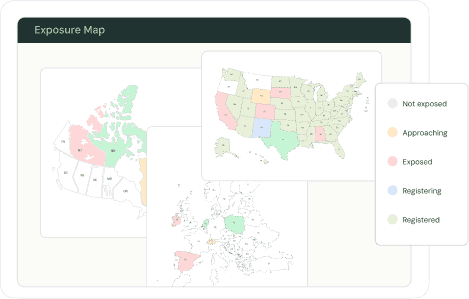
Kintsugi tracks sales activity across every state to see how close you are to crossing economic nexus thresholds. Proactive monitoring gives businesses early alerts before liability begins. This feature reduces the risk of missed registrations and costly back taxes.
Auto-Filing
Sales tax filing and remittance are done automatically and on time. You just have to approve it, so you'll only spend a few minutes a month to keep your business compliant. No need to memorize the varying due dates from different states, Kintsugi will do it for you. Kintsugi's auto-filing eliminates late fees, compliance gaps, and manual errors.
Sales tax should not take too much of your resources and peace. Stay compliant without the headache. Try Kintsugi and automate your sales tax compliance with confidence.