8 Best Multi-State Sales Tax Software Solutions
Expanding across state lines? Discover the 8 best multi-state sales tax software tools to automate economic nexus tracking, filings, and compliance.

Best Multi State Sales Tax Software 2026
Expanding your business across state lines brings more revenue, but it also introduces the massive headache of tracking economic nexus thresholds across 50 different jurisdictions.
Instead of focusing on growth, finance teams quickly get bogged down registering in new states, mapping local product taxability rules, and manually filing returns on clunky government websites every month.
Finding a platform to handle this workload is tough because basic calculators fail at cross-border complexity, while enterprise compliance systems are often too expensive and difficult to implement.
In this guide, we analyzed the best multi-state sales tax software to help you automate the administrative work and keep your business audit-ready as you scale.
How to choose the best multi state sales tax software
Selecting the right tax software depends on matching the tool to your specific business model, transaction volume, and internal resources. Use the following criteria to narrow down your options.
High-Volume E-Commerce: If you sell physical goods on Shopify or Amazon, you need a connector-first tool like TaxJar. These handle high transaction volumes without per-order fees destroying your margins.
SaaS and Digital Goods: If you sell software or subscriptions, you need a specialized engine like Anrok or Kintsugi. These platforms specifically understand digital taxability and track nexus based on customer location rather than shipping address.
Enterprise and Manufacturing: If you have complex supply chains or legacy ERPs like Oracle or SAP, you need a legacy engine like Vertex or Avalara. These are the only tools capable of handling deep customization and intricate exemption certificate management.
Rooftop Accuracy: Zip codes are not precise enough for tax compliance. Ensure the tool uses geolocation coordinates to identify special district taxes down to the specific street address.
Real-Time Nexus Alerts: The software must track your sales against state thresholds and notify you before you reach the limit. Tools that report this data retroactively leave you liable for past unpaid taxes.
End-to-End Auto-Filing: Confirm the software actually remits payment to the state. Some filing tools only generate a report or PDF, leaving you to log in to state portals and pay manually.
Sales tax pricing models are often opaque. Ask these specific questions before signing a contract:
Connector Fees: Ask if there is an additional cost just to connect the software to your shopping cart or ERP.
Zero Returns: Confirm if you are charged the full filing rate for months where you have no sales but are still legally required to file a return.
Refund Handling: Ensure the tool automatically reclaims tax credits on refunded orders so you do not overpay the state.
Quick overview of the top multi state sales tax software
Tool | Best for | Key features |
|---|---|---|
Kintsugi | High-growth e-commerce and SaaS companies scaling across multiple states | Real-time nexus tracking, AI-powered product taxability, end-to-end auto-filing, native tech stack integrations |
Avalara | Mid-market businesses and enterprise sellers with global or complex operations | Rooftop-level geolocation, over 1000 integrations, simultaneous VAT/GST and US tax support, exemption certificate management |
TaxJar | Growing e-commerce and retail brands needing intuitive US compliance | Economic nexus alerts, multi-channel dashboard for platforms like Shopify, automated state filings, intuitive interface |
Anrok | Software, SaaS, and digital product businesses with distributed remote teams | SaaS-specific taxability rules, physical nexus tracking via HR tools, automated global VAT and GST coverage |
Vertex | Multinational corporations relying on heavy ERP systems like SAP or Oracle | Precise geocode mapping, custom tax rule configuration, complex B2B transaction processing |
TaxCloud | Budget-conscious US businesses looking to leverage the Streamlined Sales Tax program | SST Certified Service Provider, free tax calculation and filing in 24 member states, real-time nexus monitoring |
Zamp | Fast-growing businesses wanting a completely hands-off managed service | Done-for-you state registrations and filings, tax notice management, all-inclusive subscription pricing |
Sovos | Massive global enterprises needing strict regulatory compliance and managed services | Global e-invoicing mandates, dedicated team of human tax experts, complex use tax tracking |
The 8 best multi state sales tax software
Kintsugi represents a fresh, modern approach to sales tax automation, specifically built to handle the complexities of the modern tech stack and multi-state expansion.
Unlike legacy providers that often run on outdated infrastructure, Kintsugi punches above its weight by giving you accuracy across thousands of local jurisdictions without the enterprise price tag.
It solves the two biggest headaches for finance teams navigating multi-state compliance: liability risk and manual administrative work. By offering a completely automated platform with transparent pricing, it allows growing businesses to scale without worrying about long-term contracts.
Why Kintsugi makes up for a great multi-state sales tax software
Kintsugi integrates directly with your billing and HR systems to monitor your economic and physical nexus across all fifty states. Instead of relying on retroactive reports, the system tracks your sales volume and alerts you the moment you cross a new state threshold. This prevents compliance gaps before they happen and ensures you never accrue unexpected back taxes.
Selling products across state lines means dealing with vastly different taxability rules for every specific item. Kintsugi uses a proprietary AI engine to automatically map your product catalog to the correct tax codes in every local jurisdiction. This eliminates the need for manual tax research and guarantees you are collecting the exact right amount at checkout.
Handling the calculations is only half the battle when selling in multiple states. Kintsugi actively manages the paperwork by automatically registering your business in new states as you trigger nexus. When deadlines approach, the platform auto-files your returns and remits the payments so your team never has to navigate another clunky state portal.
For multi-state sellers using modern tools, Kintsugi offers native syncs with platforms like Stripe, Shopify, and QuickBooks. It calculates the correct tax the moment you create an invoice or process a cart. This continuous reconciliation ensures your financial ledger matches your tax filings down to the cent without requiring any custom developer implementation.
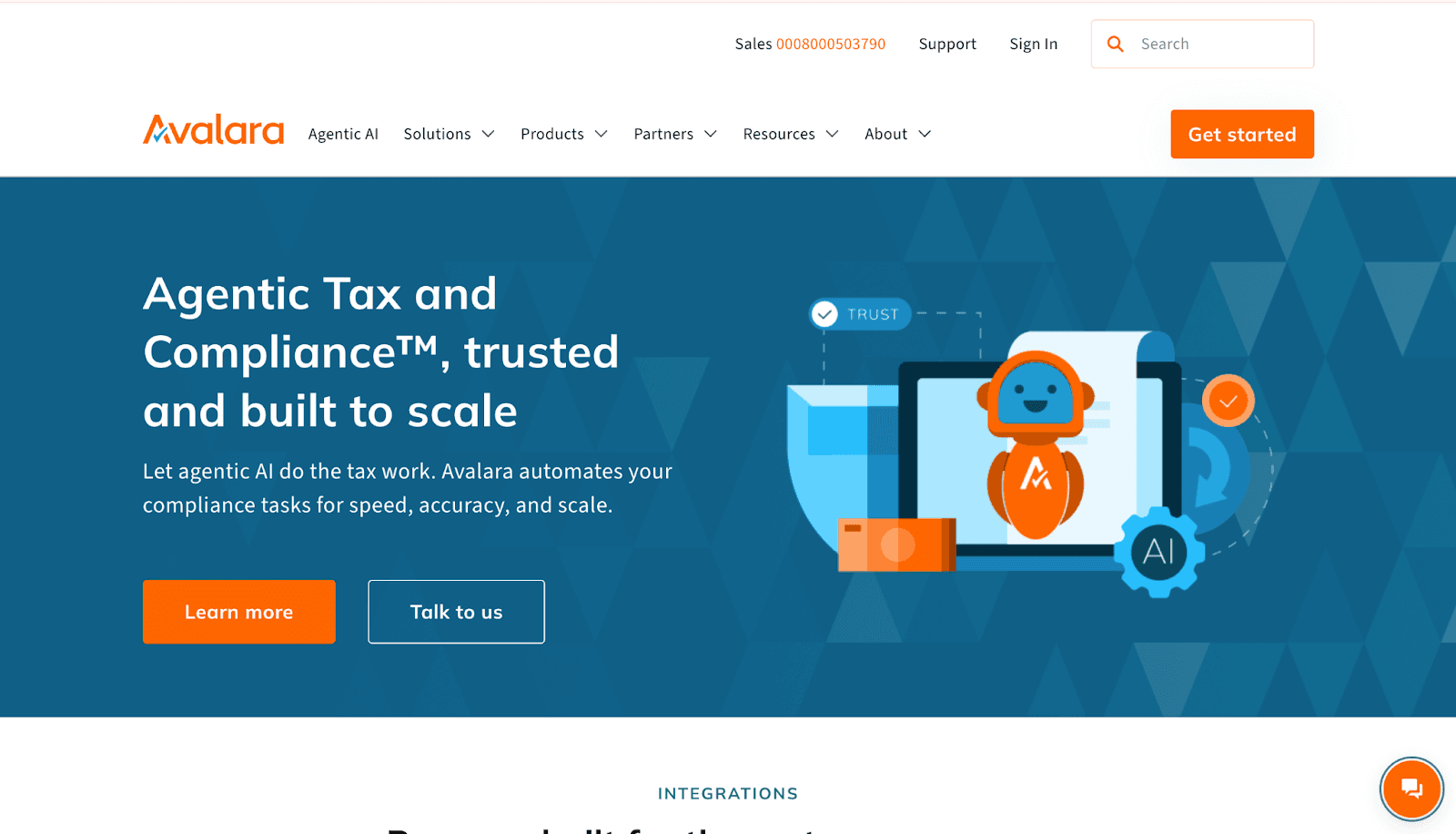
Avalara is a powerful tax engine designed primarily for large mid-market businesses and enterprise sellers. If you sell products across dozens of states where tax rates and rules vary wildly by county, city, or local municipality, Avalara can calculate the exact tax instantly at checkout using rooftop-level geolocation. It integrates with virtually every type of business software, e-commerce platform, or enterprise ERP system available, boasting over 1,000 partner integrations.
Choose if
You sell across the U.S. and globally, and you need a single, comprehensive system to handle complex multi-state sales tax, VAT, and GST simultaneously.
You sell items with tricky multi-state tax rules where taxability changes drastically from one zip code to the next.
You are an enterprise seller relying on a heavy ERP system (like SAP or NetSuite) who needs a highly customized implementation to manage sales tax and large volumes of exemption certificates.
Avoid if
You are a fast-growing startup or mid-market brand looking for a modern, out-of-the-box solution, as Avalara's setup fees, implementation time, and feature-based pricing can be heavy.
You prefer an intuitive software interface and highly responsive customer support without having to navigate a complex corporate ticketing system.
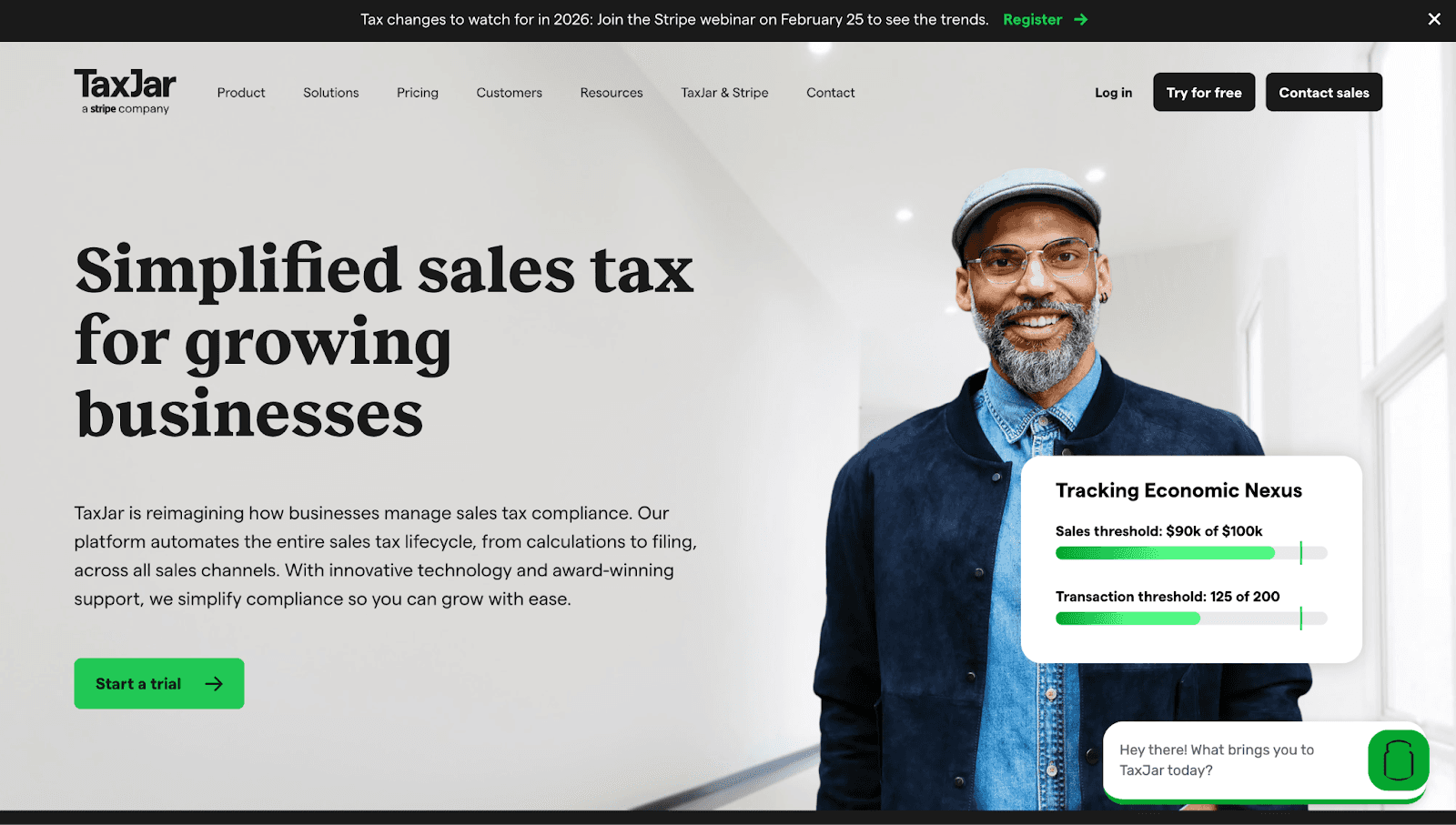
TaxJar (now owned by Stripe) is a streamlined platform built to automate multi-state sales tax for growing e-commerce brands. It tracks your sales across the country and alerts you when your transaction volume triggers an economic nexus in a new state. Once you have an obligation, it connects to your sales channels to calculate real-time tax rates and automatically submits your returns to the proper state jurisdictions.
Choose if
You are an e-commerce or retail business needing an intuitive platform to track your multi-state economic nexus and automate state filings.
You sell across several online channels like Shopify or Amazon and want a single dashboard to consolidate your multi-state tax data.
Your primary focus is United States compliance, as the tool is specifically designed for U.S. sales tax rules.
Avoid if
You process highly complex B2B transactions, as the platform has limitations around heavy customization and managing tax-exempt certificates.
You have an enterprise-scale operation requiring intricate integrations with legacy ERP systems, which larger tools generally handle better.
You prefer immediate, hands-on phone support, as the platform relies heavily on a self-serve model and email ticketing for most users.
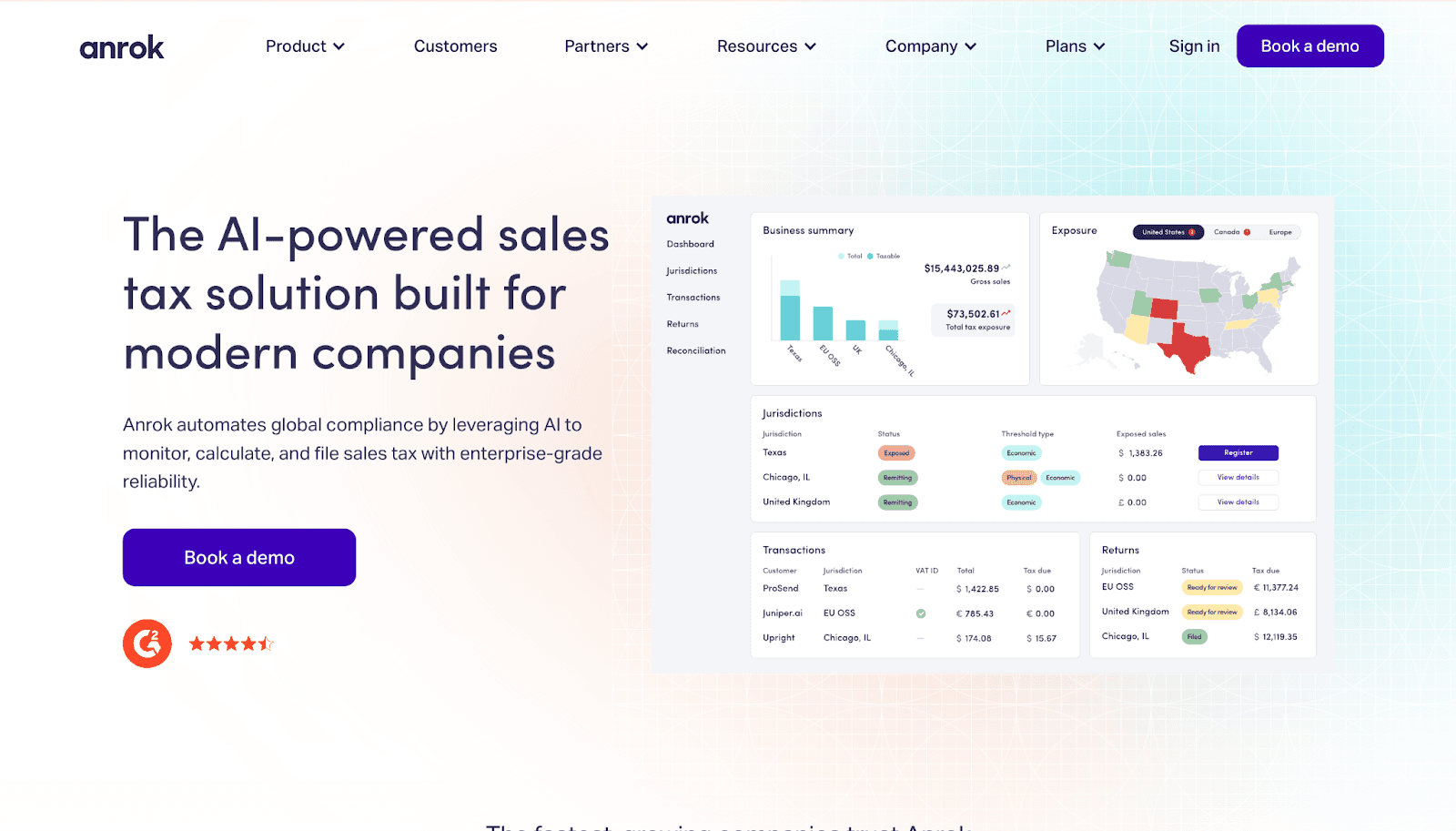
Anrok is a specialized sales tax platform built entirely for software, SaaS, and digital product businesses. Because SaaS taxability rules vary dramatically across different states and local jurisdictions, Anrok tracks both your sales volume and your remote employee locations to alert you when you have triggered a multi-state tax obligation. It connects directly to your billing and HR systems to calculate taxes based strictly on software tax rules, automatically filing returns and paying the correct jurisdictions as you scale.
Choose if
You sell subscription software, digital goods, or usage-based products and need a tool that understands the specific taxability rules for those items across different states.
You have a highly distributed remote workforce, as the platform tracks physical nexus triggered by hiring employees in new states.
You sell internationally and need a single platform to handle global VAT and GST alongside your U.S. multi-state compliance.
Avoid if
You primarily sell physical goods, clothing, or food, as the platform is built exclusively for digital products and hybrid business models.
Your business requires support for specialty tax types like property, lodging, or heavy manufacturing taxes.
You need deep integrations with legacy, on-premise ERP systems rather than modern cloud billing and HR platforms.
Vertex is an enterprise tax engine built specifically for large corporations and multinational businesses with complex tax requirements. It manages multi-state tax compliance by applying real-time tax rules and rates based on precise geocodes and individual product taxability. It connects directly to heavy ERP systems to calculate transaction taxes, handle large volumes of exemption certificates, and generate accurate returns across different state and local jurisdictions.
Choose if
You are an enterprise-level business processing massive transaction volumes across numerous U.S. states and global jurisdictions.
You rely on complex ERP systems like SAP, Oracle, or Microsoft Dynamics and need a highly customizable integration.
You have a dedicated in-house tax or IT team capable of managing an intricate implementation process and configuring custom tax rules.
Avoid if
You are a small to mid-sized business, as the platform's enterprise pricing and long-term contracts are generally geared toward much larger companies.
You want a simple, fast setup, because implementing the system often requires weeks or months of developer and IT resources.
You prefer a completely hands-off service, as the software is designed to give tax professionals direct control and often requires manual intervention.
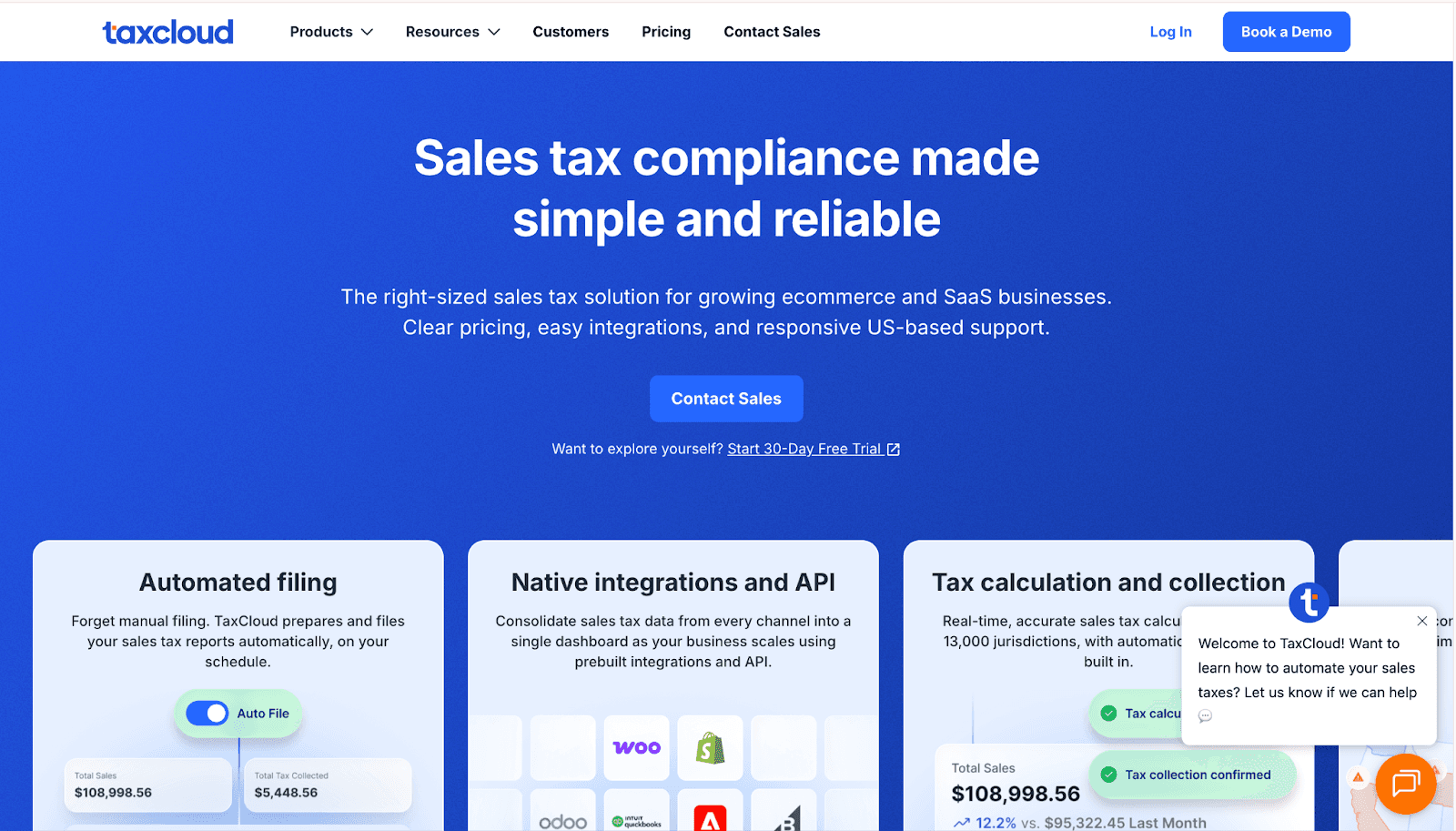
TaxCloud is a cloud-based compliance platform specifically designed for the U.S.-based e-commerce and SaaS businesses. It is best known for being a Certified Service Provider (CSP) for the Streamlined Sales Tax (SST) program.
This designation allows qualifying businesses to access free tax calculation, reporting, and filing services across 24 participating member states, making it a highly cost-effective option for managing multi-state compliance. It integrates directly with popular online shopping carts and marketplaces to provide real-time nexus monitoring and automated state filings.
Choose if
You are a budget-conscious U.S. business looking to leverage the Streamlined Sales Tax (SST) program to offset the costs of multi-state tax filings.
You run an e-commerce or SaaS brand and need a straightforward tool to track economic nexus and automate calculations across all 13,000+ U.S. jurisdictions.
You prefer transparent pricing and access to hands-on, U.S.-based customer support without paying for an enterprise-level service.
Avoid if
You sell globally and need a platform that can handle international VAT, GST, and customs duties, as TaxCloud is focused almost exclusively on U.S. sales tax compliance.
You operate a large enterprise with highly complex physical supply chains and require deep, custom integrations with legacy ERP systems.
You need advanced, highly customizable B2B features or specialized tax logic for heavily regulated industries like telecommunications or excise tax.
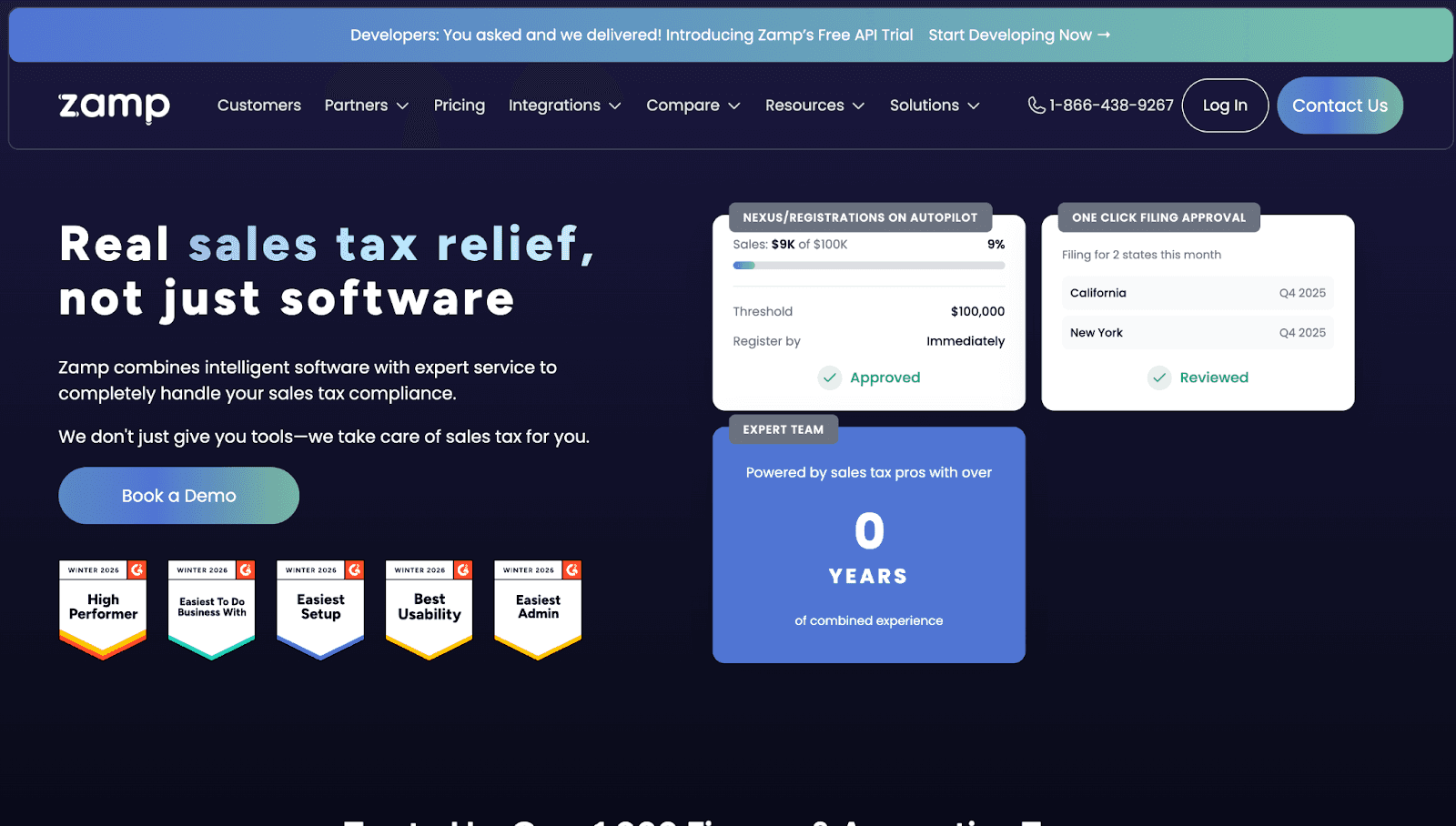
Zamp distinguishes itself by being a managed solution rather than just a software tool, combining automated technology with a team of human tax experts. Instead of simply providing a dashboard for you to manage your own compliance, Zamp takes a done-for-you approach where they handle the entire process—from initial state registrations and nexus tracking to filing returns and managing tax notices.
Choose if
You want a completely hands-off experience where a dedicated team handles your state registrations, filings, and tax notices for you.
You prefer a single, all-inclusive price that covers unlimited filings and registrations, avoiding the "per-return" fees common with other providers.
You are a fast-growing e-commerce or SaaS business that wants to outsource the entire tax function rather than hiring an internal tax manager.
Avoid if
You are a very early-stage business with low sales volume, as the minimum monthly service fees may be higher than basic DIY software options.
You prefer to maintain direct, hands-on control over your filings and payments rather than delegating approval to a third-party service.
You require deep integrations with highly specialized or legacy on-premise ERP systems, which are typically better supported by older enterprise giants.
Sovos is an enterprise-level compliance platform designed to manage both U.S. multi-state sales tax and complex global indirect taxes like VAT and GST. Rather than just offering self-serve software, Sovos heavily emphasizes a managed services approach, providing large businesses with a dedicated team of tax experts to handle monthly filings and regulatory changes. It connects directly to heavy ERP environments to automate multi-state tax determinations, manage high volumes of exemption certificates, and track use tax liabilities across thousands of local jurisdictions.
Choose if
You operate a massive global enterprise and need a single platform to manage U.S. multi-state sales tax alongside international e-invoicing and VAT mandates.
You rely on complex ERP systems like SAP or Oracle and require a highly customized implementation to ensure accurate tax routing.
You prefer to outsource your compliance to a dedicated team of tax professionals rather than managing the day-to-day software alerts yourself.
Avoid if
You are a small or mid-sized business looking for a simple, fast setup, as the platform is built primarily for Fortune 500-level operations.
You want a highly intuitive, unified software interface, as users often note that navigating between the platform's separate compliance portals can feel fragmented.
You prefer immediate, fast-acting customer support, as resolving technical issues can sometimes require navigating a complex ticketing system.
Choosing the best multi state sales tax software
Selecting the right multi-state tax solution is less about comparing feature lists and more about matching the tool to your current growth stage and compliance risk.
If you are staying local: For small businesses with a physical presence in just one state and sales below economic nexus thresholds, dedicated multi-state software is likely unnecessary. The built-in tax calculators within your existing shopping cart or basic state-provided portals are usually enough to manage a single jurisdiction without adding monthly overhead.
If you are scaling quickly: This is the tipping point where compliance risks skyrocket. Once your transaction volume triggers economic nexus across multiple state lines, the cost of potential audits and manual data entry far exceeds the price of software. At this stage, prioritize a modern, AI-driven platform that automates the entire lifecycle—from nexus monitoring to filing—so your finance team isn't bogged down by administrative work.
If you have complex legacy needs: For massive enterprises managing intricate supply chains, specialized B2B exemptions, or older on-premise ERP systems, operational breadth takes precedence over speed. You will need a heavy-duty legacy engine capable of handling highly specific taxability rules and custom integrations, even if it means accepting a longer, more expensive implementation process.
FAQs
1. What is the difference between physical and economic nexus?
Physical nexus happens when you have a tangible presence like an office or employee in a state. Economic nexus occurs when your out of state sales cross a specific revenue or transaction limit.
2. Do I need multi state sales tax software if I only have one office?
Yes, selling online to customers nationwide can trigger economic nexus in entirely different states. You must legally collect and remit taxes there once you cross their specific sales thresholds.
3. How does sales tax software track when I need to register?
Modern platforms connect to your billing system to monitor your live transaction data. They actively alert you the moment your sales volume crosses a new state liability threshold.
4. Are SaaS and digital goods subject to multi state sales tax?
Yes, but tax rules for digital products vary wildly by local jurisdiction. Specialized tax software automatically maps your specific digital items to the correct local tax codes everywhere you sell.